Sunday, 18 May 2014

Righting wrongs

Finding a new book on the Battle of Crécy seemed like heaven.  It was brand new, untouched, unopened, and best of all it was in a charity shop for a fraction of its cover price.  I was thrilled.  Once home, and without the time to start reading it cover to cover, I decided to see what was said about my fave Emperor, who fought at Crécy.  I wish I hadn't bothered.  What I found there left me feeling very grumpy and unsure if I want to read the rest.

Few things annoy me more than lax research.  I'm not talking about the things that were thought to be correct at time of publication, or that hard-to-track-down detail that you only find when it is too late - these are unavoidable. I'm talking about the things that could have been checked, should have been checked, or those details that have been misunderstood, or taken as truth without corroboration.

This happens, and it annoys me no end.  Along with the above mentioned book, I found similar research 'fails' in another book, a novel, so I think it is time to respond. 

The young Charles
I have already spoken about the person in question - Charles IV of Bohemia, Holy Roman Emperor, and you can read more about him here.

In the text book I leafed through (then tossed aside in bemusement) Charles was scandalously portrayed as being a puppet to his father and a coward who not only arrived late to the battle but then left the field as soon as the going got tough, and then refused to speak about it afterwards.  These opinions appear to be based on English sources which consistently use the phrases 'I know not' and 'so men say' which suggests to me that they hadn't actually got a clue what Charles was up to during the battle and smacks of gossip.  Where the idea that he never mentioned it again came from I have no idea.

However, Czech sources are not so devoid of detail and Charles is recorded as having played an important role in the whole campaign.  He was in Paris and saw the campfires of the English army as it paused at Poissy to repair the bridge.  He was at Saigneville and Blanchetaque on the heels of the English as they forded the Somme to escape the French trap.  He was with the King of France at Crécy itself to advise.

In the battle he charged, possibly even as soon as in the first wave alongside the count of Alençon, the French king's brother who was one of the many high ranking casualties on the French side, and we are told he only left the field again by being dragged away by his men after his father was dead.  He had been injured in the arm twice.  On the demise of his father he became a count and a king twice over so one can understand why his men were so fearful for him - he'd just become the most powerful man in Europe bar the pope.

So we have two groups of sources, English and Czech.  The English sources got their information, well, who knows where.  It is not recorded.  'Men' is as close as we can get, though as one chronicler is Jean Froissart it is assumed that someone close to King Edward gave him the information.  But had this been the case surely Froissart could give names to these eye-witnesses.  So maybe he was not as close to the king's inner circle as has been assumed.  The Czech source is actually two, one derived from the other.  The earlier is by one František Pražský who wrote about Crécy but he fell out of favour with Charles and a new chronicler was appointed, Beneš Krabice z. Weitmile.  We can assume that as Charles appointed him particularly, he had some input over what was written about him.  And Krabice based his account on František's existing work and the account of Crécy was retained, thus, we have to assume, was approved by Charles.  Two chronicles discussing the same event is not what you expect from someone who doesn't want to talk about it.

When examining sources a good researcher will ask various questions - who wrote this? For whom? What was his aim? With what authority did he write? There are others but these are good ones to start with and allow you to build up an idea of the bias, and there is always a bias.  We can say with some certainty that regardless of what happened, Charles approved of the record of events written by František to allow his own chronicler to use it as a base.  Whether František was as much the king's man as Krabice really doesn't matter because what he said was accepted by Charles personally for Krabice to be allowed to continue to use it.  Does this mean it is gospel truth? No, it doesn't, but contains input from a named someone who was indisputably there, unlike the main English source Froissart.

But what of those English sources?  We already know without doubt that Froissart 'made things up' - he gives an account of a conversation between John of Bohemia and his knights that Froissart and no Englishman could possibly have overheard.  The English sources have no particular authority given, no names, unlike the Czech chronicles, but what would the English have to gain by maligning the Emperor?  Plenty actually.  Charles had been elected Holy Roman Emperor just weeks before the battle.  There was, however, already an Emperor, Ludwig of Bavaria, the same Ludwig who was Edward III of England's ally in Europe, and was also his brother-in-law.  Charles also had the ear of the pope, Clement VI who had been Charles' childhood tutor and was no friend to England and who exercised a definite French bias.  Defaming Charles and suggesting he was a coward would have been something of a cheap shot but one that, had it caught on, would have been difficult to dispute in the confusion of battle.  However, there is less out there to suggest the negative view is more true than the positive, that he was an admired, possibly sought-after, warrior and an astute statesman.

Comparing sources is just part of the problem here.  Yes, you can compare and contrast and find the bias, but they are still just a snapshot of an event.  To get a better idea of whether the allegations are believable or just absurd, looking at Charles himself sheds more light.  Was he a coward? What had he done before?  Who was Charles?

The Battle of Crécy from a
French manuscript
And if you look at Charles' life up to 1346 you find a man who was anything but a coward.  Charles fought in his first battle aged fifteen, fighting the forces of several Italian city states whilst protecting his father's interests in Italy.  He was young, even for the times, to lead a force, but he did.  And he nearly lost, having his horse killed under him and yet he stayed, facing certain failure.  But he didn't lose.  He won, and he was knighted there and then.  (I must here point out that this was a year younger than Edward, the Prince of Wales who became known as the Black Prince, the flower of English chivalry and famous warrior who was knighted at sixteen years of age.)  He chose to fight on the side of the Venetians in Italy when he had absolutely no reason to do so.  He fought alongside his father in Lithuania.  He had suffered injuries in his first battle, and went on to fight again.  He rode to war against his rival Ludwig after the events of Crécy.  These are not the actions of a man who was afraid of a battle or of losing his life.  And one must remember that dynastically speaking his survival was not essential - he had a full brother to inherit Bohemia and a half brother destined to take control of Luxembourg.

Two other allegations that are levelled at Charles in the same tome are that he was a puppet of his father and that somehow his youth went against him, referred to several times, rather disparagingly as 'young Charles'.  The first of these is just not true. Charles was his own man.  He changed his name, when only seven years old, not to honour his father but the man who was in reality bringing him up, King Charles IV of France.  Charles did go to Italy when required, at the tender age of fourteen, and began to govern his father's lands.  But he founded a town and called it Montecarlo after himself, not Montegiovanni for his father.  He chose to leave Italy to return to Bohemia, his father only agreeing once it was a fait accompli, where he began to re-establish the monarchy after years of neglect by his father, and that included an army that answered to him.  Raising it to come to the aid of his brother in Tyrol, and thereby proving his own personal power, caused a major rift between him and his father that took years to resolve.  His activities for the Venetians were entirely by his choice - he was keeping out of the way of his father because of the issue with the Bohemian army at the time.

And so to his supposed 'youth' at the battle of Crécy.  Let's have a closer look at the major combatants, from both sides.  Charles was thirty.  King Philip VI of France was fifty-three.  John of Bohemia was fifty. Charles count of Alençon was forty-nine.  Edward III of England was thirty-three.  William Bohun, earl of Northampton was thirty-four.  Thomas Beauchamp, earl of Warwick was thirty-two.  John de Vere, earl of Oxford was thirty-four.  Sir Thomas Holland was thirty-two.  Lord Bartholomew Burghersh was around 26.  Edward, Prince of Wales was sixteen.  Enough said.

It is certainly worth noting how Charles is viewed by the Czech people when examining him and his supposed cowardice and weakness.  My Czech friend's expression of confusion and disbelief when I put this version to her told me pretty much all I needed to know.  However, she explained that Czech children are taught that Charles' survival at Crécy was 'miraculous'.  In 2005 he was voted the greatest Czech to have ever lived and you can read a little more about that here.  There is no suggestion in the national consciousness of a man who fled a battlefield a coward.  Today Czech children learn about Crécy because of Charles and his father, whereas in England, the side who actually won, school children have no idea what it is.

Charles with the crown of the 
Holy Roman Empire
The second book is a work of fiction which left me more deeply disappointed as it was written by an author I had trusted and liked.  Poor fact checking was one sin - stating more than once that the river Seine could be followed from Rennes to Paris was unforgivable.  I mean, how hard is it to check a map? And did no one think to verify this at the editing stage?  Similarly the writer did not check the date of birth of Edward III, referring to him as being thirty-four at Crécy.  Edward was born on 13th November 1312 so he did not turn thirty four for another two and a half months.

But what really rubbed me up the wrong way was how the writer killed off Charles, stating that he bled to death on his father's body.  It is such a bizarre thing to do.  His 'death' wasn't a plot twist, a device to further the story, and there was no tension created by it, no conflict.  It served no purpose except to be wrong.  Surely it would have been better to leave Charles out of it altogether than to go so disastrously astray.  

And as if to underline the inaccuracies in the novel, the author also kills off King Jaume III of Mallorca who, like Charles, fought for the French.  Jaume did die in battle, but not this battle.  He perished in the battle of Llucmajor, Mallorca, on 25th October 1349.  His input into the battle of Crécy is sketchy at best and he certainly didn't distinguish himself, but he survived it.  There is one more high profile victim of this author - the Count of St Pol was also slain at this fictional version of Crécy.  Guy de Chatillon, who became Count of St Pol in 1344, died in London in 1360 serving as a hostage following the Treaty of Brétigny. The treaty allowed for the release of King John of France, who had been captured at the Battle of Poitiers in 1356, in exchange for other hostages and Guy was one of those.

So that is three very high ranking people who were erroneously killed off at Crécy who in reality went on to live for years, thirty-two more years in the case of Charles.  Did the author know?  Did he care?

I am staggered to discover how little-known Charles is in England - and I was just as guilty until last year, but then I'm not a professional historian nor serious novelist - still more that such things as his supposed death at Crécy can be accepted so readily and without question, and can be written by someone without a stab of guilt.  One day, maybe, I will contact the author and simply ask why he did it, but until then I will sit and fume to myself and continue to write about what an extraordinary man Charles really was.

Wednesday, 7 May 2014

Was Hamlet just an inept King Edward III?

'Hamlet' has been the centre of much study and the focus of a great deal of theories and character analysis.  Was he oedipal?  Was he bi-polar?  But there is one study I have not seen, and that is an examination of the parallels between Hamlet and King Edward III.

Edward III holding court after 1339
Their stories are strikingly similar - they were both princes and heirs to their respective thrones, both of their fathers were murdered*, both of their mothers entered into a relationship with the man responsible who then assumed power, and both resorted to the use of subterfuge in order to gain their revenge. 

The outcomes were very different.  Hamlet famously perished, killed by the touch of a poisoned sword, his close friend Horatio at his side.  Edward survived, thrived, and ruled for fifty years, surrounded by good, loyal friends.

So, one was successful, one was not.  But was Hamlet doomed from the beginning?  And if so, does that diminish what Edward achieved or does it make him all the more remarkable?

Hamlet's father was killed by Claudius and the first Hamlet knew of any trouble was when he was recalled from university.  He only learned that the death was murder when he spoke to his father's ghost.  By then his mother was already married to Claudius.  Hamlet struggled with the task he was given by his father - avenging his death - and it brought him low.  He contemplated suicide more than once during the play, speaking of 'self-slaughter', and again most famously in his 'To be or not to be' speech.  Was this a natural reaction for a young man in his situation, to the discovery of the murder of his father and his mother's hasty remarriage, to the loss of his birthright to be king after his father?  Or was Hamlet always going to feel this way, even had his father not been murdered, had died a natural death?  Could he ever have ruled?  Was his personality suited to kingship?

The sensible way to answer this would be to look at someone who struggled with a similar situation - King Edward III. 

Edward III's coronation in 1327
Edward's mother, Queen Isabella, began an affair, under his nose, with Roger Mortimer when she took Edward to Paris.  His father, Edward II, sent him numerous, and increasingly distressing, letters demanding he return to England, but he was unable to comply.  The new couple, Isabella and Mortimer, raised an army to invade England, effectively selling Edward's hand in marriage to Hainault for soldiers to swell the ranks.  They captured his father, imprisoned him and persuaded Parliament to declare young Edward king.  However Edward refused until his father had renounced the throne himself and only then did the young prince agree to be crowned.  But despite his new status, Edward was forced to allow his mother's lover Mortimer to take his place, ruling as king in his stead.  He was just fourteen.

Edward was then under what was virtual house arrest with a small household who were constantly monitored and spied on, again reminiscent of the activity at Elsinore that Hamlet so despised, hence the only way Edward could convey his own thoughts to the pope was by subterfuge, adding code words to his letters, another parallel with 'Hamlet' where altered letters play an important part.  All this, you would think, would be enough to make anyone melancholy. 

And yet Edward does not appear to have reacted this way.  He appears to have been a far stronger, more resilient person than Hamlet while facing similar adversity to the Danish prince, more in fact when you consider that Edward was actually expendable as he had a brother (and his father may not have been dead after all*).  His solution was to act and not delay as Hamlet did.  When Roger Mortimer, rightly, suspected a plot and threatened Edward's friends, Edward acted that same day to remove him.  Maybe his childhood at his father's troubled court had prepared him for such a life, whereas Hamlet's childhood appears to have been idyllic.

Another characteristic of Hamlet was his animosity towards his mother demonstrated and much debated in the 'Closet' scene where Hamlet confronts Gertrude - "Good night: but go not to mine uncle's bed; Assume a virtue, if you have it not."  What Edward thought of his mother is unrecorded, but he did not punish her unduly though he must have been as furious at her as Hamlet was at his mother, and she remained a part of his life.  That she referred to her husband in a letter mere months before his deposition as 'my very sweet heart' (mon tresdoutz coer) and that she requested that she be buried with Edward II's heart suggest she may have later regretted her actions as Gertrude did, though she was far more guilty than the deluded Danish queen.

Hamlet and Ophelia
Both princes had a significant woman in their life, a lover, a paramour, and maybe the differing ways in which they approached love could explain why one failed and one did not.  Hamlet chose who he loved and he declared he loved Ophelia, but only really expressing such sentiments after she was dead.  He did all he could to distance her from him and eventually sent her mad, her committing that act that had so troubled Hamlet - suicide - and drowning herself, albeit with some sense of diminished responsibility. 

Again, for Edward, everything was the opposite and played out very differently - he had been forced into an arranged marriage, being told pretty much to take his pick of the Hainault daughters.  He selected Philippa, the eldest unmarried daughter in the family.  He had every reason to resent Philippa, if not for herself then for the circumstances of their union.  But he did not.  He and Philippa made the absolute best of their situation, probably clinging to each other in adversity, both still so young, and producing at the earliest practical opportunity (Philippa was sixteen, Edward seventeen) the son and heir that was so necessary to their security.  Having someone to confide in, someone he could not be separated from, maybe made a difference to Edward, gave him a comfort that Hamlet denied himself.

There is one similarity between Hamlet and Edward where they both used the same tactic to further their interests in their dramas, and it worked for them both, and that is the element of subterfuge. I've already touched on the letters they both used but there was another instance for them both.  Hamlet used a false play to cause Claudius to declare himself, to prove himself guilty - "the play's the thing wherein we'll catch the conscience of the king."  Claudius reacts to the dramatic murder scene and seals his fate in the eyes of Hamlet.  Edward resorted to subterfuge simply and literally to catch a king, or in his case, a usurper.  Once his friends had been threatened by Roger Mortimer at Nottingham and Edward knew he had to do something, he ordered his friends to gain entry to the locked castle using hidden underground passages and thereby catch Mortimer unawares and arrest him before his own retinue had time to react.  It is one of the few instances where both young men achieved what they wanted - subterfuge obviously works!

The final scene in 'Hamlet'
Ultimately, though, Hamlet failed.  Yes, he avenged the death of his father but the price was very, very high.  He sends Ophelia to an early grave, he murders her father and her brother Laertes, his mother is killed with the poisoned wine meant for him and he succumbs to a poisoned blade.  Hamlet is remembered for his inaction and delay and his melancholy in the face of adversity.  Edward on the other hand succeeded spectacularly.  He arrested Roger Mortimer and his closest allies with little fuss.  His mother, we must presume, repented, and she lived comfortably into old age.  He loved the wife who was pressed upon him and they had a long and happy marriage and had a lot of children.  Edward proved himself capable and was a known across Europe as a man of action and one who knew how to enjoy himself.  We must assume, therefore, that Hamlet's personality doomed him and not his circumstances.

Shakespeare was familiar with Edward's story, he had read Holinshed, took much of the detail for his history plays from that chronicle, and there is a great deal of detail about Edward III in the 1577 version.  He is suggested as a collaborator on the play 'The Reign of King Edward III' and if so he was intimate with the history and must have read Froissart, the go-to source for Edward's reign which is the basis for the play.  Even if he was not a writer of it, he most certainly would have known it.  Whether he took elements of the king's life and included them in his version of 'Hamlet', consciously or subconsciously I don't know, I have not read any other study on this aspect of 'Hamlet' and I personally have not had the chance to delve any deeper than I have here, but the parallels are certainly striking.


* It is generally held that Edward II died at Berkeley castle in September 1327 but in recent years material has surfaced that has thrown new light on old sources suggesting that he did in fact survive not just beyond 1327 but possibly into the 1340s, living hidden in northern Italy with the odd trip into Germany to meet with his son.  Many 'old school' historians deny this version of events, but the growing body of evidence is more and more compelling and makes far more sense than the opposing view.  For more information on this line of enquiry take a look at Ian Mortimer's book Medieval Intrigue, Kathryn Warner's website and the Auramala Project. 

Friday, 2 May 2014

When Little Ballerinas Grow Up


Me 'en pointe'
To move away from History for a moment I decided this week to talk about another passion of mine - ballet.  

I love history and there is nothing preventing me from indulging whenever I choose, with a book, a film, a novel perhaps.  But when I go on holiday it is not a history text that I pack - it is my pointe shoes.

I can't remember a time before I danced.  I do remember my first ever class, hazily, but I don't remember what I did before that.  I attended a small school near my home for several years until after I did my first exam, which I passed despite the appalling pianist trying to muck it up.  So I left, and it was the best thing that could have happened to me.

My mum never gets the recognition she deserves for finding my next school, the Muriel Thomas School of Ballet in Rochester, which went back to at least 1956 and there is even a little Pathé news film of them here.  So, thank you Mum, for finding the school and to you and Dad for sitting in a cold waiting room for me week in, week out, and ferrying me to and fro, and any friends I decided to foist on you.

By the time I joined, Muriel had handed the ribbons to Miss Jenny, her daughter, and I remained with her for over a decade.  It is down to her that I am as well trained as I am.  She worked me hard but she was never a bully. She ensured that we knew the syllabus inside out, that we understood what all that French meant, the theory behind port de bras, pliés, and she drummed it into us so thoroughly that I still remember most of it.  She taught us the behind the scenes tricks of the trade, how to care for your satin shoes, how to darn the tips of your pointe shoes, how to tie the ribbons, how to score the sole to improve grip, where to put the animal wool (there were no fancy toe protectors back then).  She took me through five exams successfully over those years, and she believed in me and my ability, even trying to persuade my parents to send me to ballet school, which sadly fell on deaf ears.  She was amazing and I owe her so much.

Ballet even influenced my
GCSE artwork
And then life took over.  I had maintained my ballet through my 11+ exam, my GCSEs, my A-Levels, always finding the time to go to as many classes as Miss Jenny would let me, earning my place through being a teaching assistant for every class lower than my own, dancing for seven hours every Saturday and several more on a Wednesday after school.  Going to university was a different matter.  Aberystwyth is a long way from Rochester.  But along with my books I packed my pointe shoes.  However I only took one class at uni. I fled, distraught, having been told that my French full plié in fourth was 'wrong' but little did I know that I would revisit this 'wrong' plié many, many years later.

I didn't think that I missed ballet all that much.  I was satisfied with what I had achieved in ballet and Life took me in some interesting directions which were enormous fun, but now I look back I realise that giving up ballet had left a painful hole that, while being ignored, had affected me.  I rejected ballet - I had stopped watching ballet on TV, stopped looking at my books.  I did not see a ballet in a theatre until I was in my thirties.  I did some T'ai Chi and yoga but resented them for not being ballet.  And yet wherever I went my pointe shoes went as well, if only to hang on the wall.

My old Freed pointe shoes -
the loose shank was
part of breaking them in
Twenty years later I regained that part of me I hadn't realised I'd lost.  While looking for a class for my daughter, Junice, the proprietor of the first school on my list, said there was a class I could do if I wanted to give it a go.  So I went along to my second ever Italian Cecchetti class, complete with that 'wrong' plié.  I was the oldest by some margin, ten years older than the teacher, and I was dancing alongside girls as young as fourteen.  They politely ignored me, the old lady in the brand new soft shoes that didn't quite fit, until I brought out my trusty Freed pointe shoes with their ragged darning on the toes, heavily worn and danced in.  Those shoes proved that I had danced before and broke the ice with the other girls who were fascinated by them and their obvious antiquity.

The class now is taught by a lady Miss Jenny would have approved of.  Junice is made of the same stuff - hard, gritty, and knowledgeable - and can still dance rings around us even in her sneakers, and, just like Miss Jenny, is tough on us, but completely fair.  The three of us who have stuck it out this far despite Life, GCSEs and A-Levels, are working harder than ever. We have to as we are tackling a professional level exam with only an hour and half tuition a week, but under Junice we are improving in leaps, bounds and grands jetés and when she says "Now you look like dancers," we know it is all worth it and we've earned the praise.

Through the fabulous medium of Twitter I have met up with other 'adult' ballerinas (HATE that phrase - dancers dance regardless of age, as I prove every class) and I can fully indulge my love of dancing with people who understand and don't look at me as if I have lost my marbles doing a 'kids' activity in my forties. The Swan Lake masterclass was the most fun I've had with my pointe shoes on.

Now, for various reasons, I face a sabbatical from ballet again.  This time my pointe shoes will not just adorn my wall but will be worn in anger and I will still dance, if only in my kitchen with a dog-eared copy of the syllabus. I have left an exam undone, a loose ribbon that needs to be tied.  So it is au revoir not adieu, and I will be back.


Wednesday, 23 April 2014

The Textus Roffensis - England's forgotten jewel


Everyone knows the names of the great documents of English history, Domesday Book and Magna Carta, but England produced documents long before the Normans arrived.  One of the far lesser known documents is the Textus Roffensis, the Book of Rochester, which, despite what the name suggests, has national importance.

The Textus is really two volumes bound into one, a collecting together of carefully selected old documents that were all copied at the same time and eventually came to be bound together.  They are not unconnected, indeed both volumes were written out by the same scribe and finished off by later hands.  One volume contains a copy of the laws of Æthelberht, king of Kent who, in 597, invited St Augustine to England to reintroduce Christianity to England and thus founded the cathedrals of Canterbury and Rochester.  It also contains a copy of the coronation charter of King Henry I from 1100.  The second contains a register of varying kinds of document, grants, charters and lists.

Lists of bishops.
Later names were added by different scribes
The Textus itself dates back to around 1122 and its compilation was almost certainly directed by Bishop Ernulf, a cleric of Bec, the same institution that produced the great Archbishop of Canterbury, Lanfranc.  It was written, as I said, by one single scribe, one who was highly accomplished and was probably Prior Ordwine.  It was bound into one document at around 1314 and generally left alone beyond a few annotations in the margin from various hands up to the 17th century. Each page was numbered using arabic numerals which were only in use in England from around 1300 onwards, fitting with a binding date of c.1314.  We can say with some certainty that this was the case as the register volume contains lists of Archbishops of Canterbury and bishops of Rochester but both cease at 1314, Walter for Canterbury and Hamo of Rochester.  It was probably Hamo who directed it to be bound, a great promoter of Rochester cathedral.

The laws of Æthelberht as found in the Textus Roffensis is the earliest surviving codified law in the English language.  Written law was a sign of civilisation in Europe and to write down laws was to promote Kent.  Allowing St Augustine to visit would have been another sign that Æthelberht wanted to be seen as innovative, a renaissance man of his time.  Can we be sure that this is genuinely from Æthelberht's time? There will always be a touch of doubt over such a long period of time, these laws were already 500 years old when they were copied by Ordwine, but the language of the text is archaic English, the Jutish dialect which was never as widespread as West Saxon, and was lost when Mercian and West Midland dialects went on to become the base of the Middle English more familiar to Ordwine.  It couldn't be re-created.  Also, the laws were not attributed to Æthelberht but to the people of Kent, which was an early Frankish style, but later, say in the time of Alfred a little over 200 years later, it was the king who headed the law, not the people.

The only illuminated letter
 in the Textus
Henry I's coronation of charter of 1100 is also important as it is the oldest known copy of the document in existence, copied out in 1122 at the same time as the laws above.  In his coronation charter Henry promised to uphold the laws of Edward the Confessor.  The Rochester scriptorium preserved a version of the basis of them, Æthelberht's laws, a version for Ordwine to copy - did Henry use it?  He was known to the cathedral, its bishop, Gundulf, witnessed the coronation charter in 1100 and later in 1130 Henry attended the cathedral's re-consecration ceremony. The coronation charter was known to the rebel barons of 1215 and formed a loose basis for Magna Carta.

The other documents contained in the Textus Roffensis include two grants of land to the St Andrew's church in 604.  It is quite possible that both of these are forgeries, one almost certainly is, but if the other is not it could be the earliest record of English place names and street names.  Why would anyone forge grants of land from 604?  The answer lies in the other documents included by the same scribe in the Textus.

There is a list that contains details of all the parishes that paid for and received chrism from the cathedral, chrism being a holy oil for use in baptisms.  This list dates to 1080 at the latest, and is possibly pre-conquest.  It certainly pre-dates the great survey of England, Domesday Book.  Such a list records subservient parishes to the cathedral and sets out its rights over them.  Couple this with grants of land, you further extend, record and emphasis the cathedral's rights and responsibilities. This would be very useful if the need arose to assert those rights if they were ever encroached upon, or, in the case of Domesday Book, prove to an outside authority. 


Pages of the Textus showing marginalia,
arabic numerals and water damage
after it was dropped in the River Medway
Consider the situation here - Anglo Saxon monks and an accomplished Anglo Saxon Prior with a highly regarded Norman bishop asserting the rights of an institution founded under a forward thinking Anglo Saxon king, asserting its rights to land granted before the conquest.  Bishop Ernulf was recording the heritage of his institution from before the Norman conquest, a self-conscious act to preserve and recognise its entire history, not just the few years under Norman influence.  There was no mass sweeping away of all that came before by the Normans.  Bishop Ernulf protected his bishopric and his priory and that, for me, is the poignancy of this collection of documents - the explicit cooperation between conqueror and conquered to protect something that transcended both.

The Textus was always a valuable book and it was lent to several supposedly trustworthy people over the years.  It suffered a few accidents along the way.  In 1631 the volume was taken to London and in the absence of its recipient at the appointed boarding house, was left with the landlord's wife, who promptly sold it for 5s to a Dr Thomas Leonard.  Nothing short of a court case could prevail upon Dr Leonard to hand it back.  And on another occasion, on its way back from another trip to London it, somehow, ended up in the river Medway.  Water and vellum do not mix and the pages were damaged by the presumably dirty water and still show signs of shrinkage after restoration.

The new works in Rochester cathedral crypt will provide a light-sensitive display environment for this remarkable document to be displayed.  Maybe then more people will know of it and understand its place in the history of England.


Wednesday, 16 April 2014

In Contemplation of Bones


Continuing my adventures at Rochester cathedral.

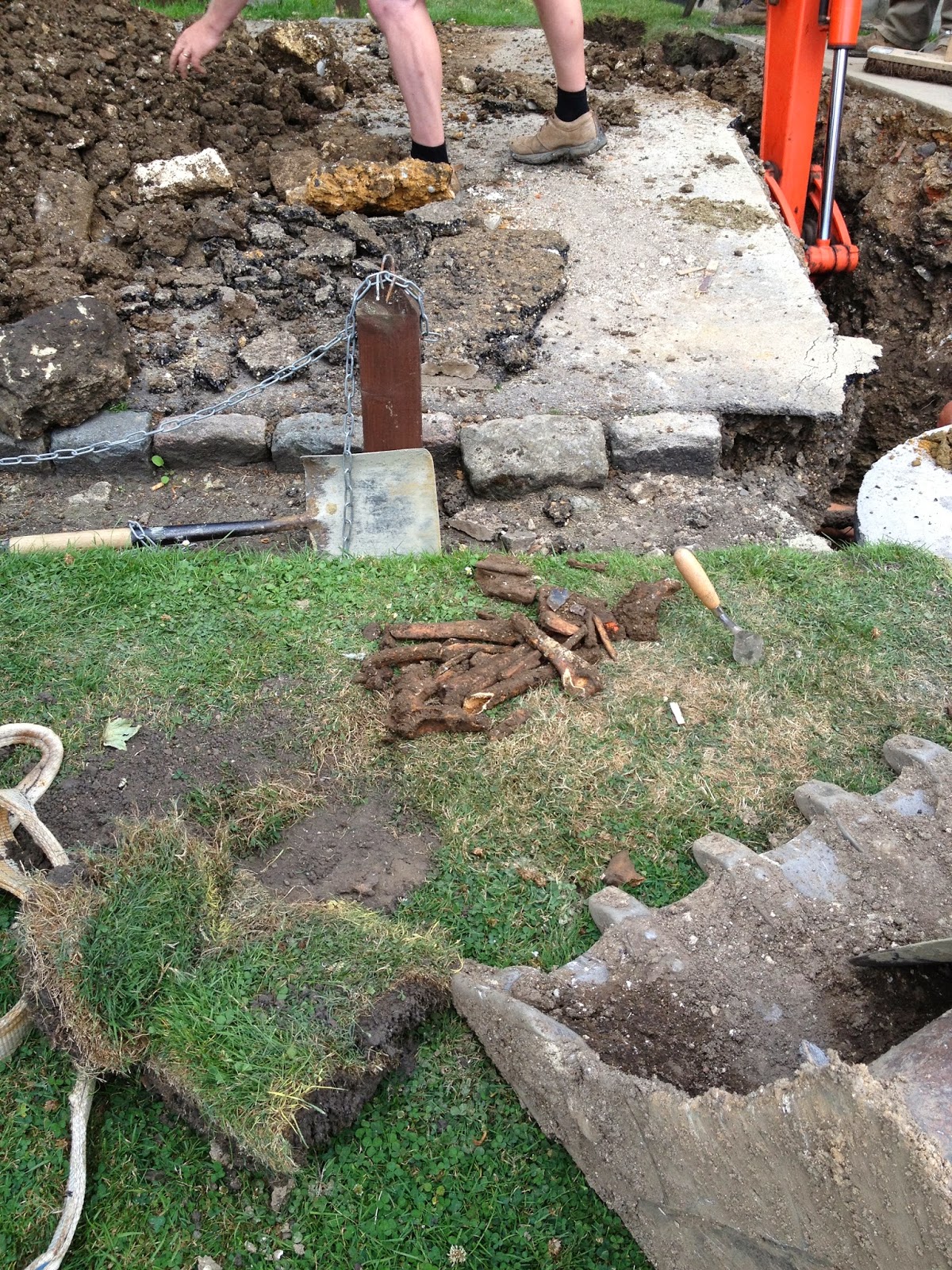
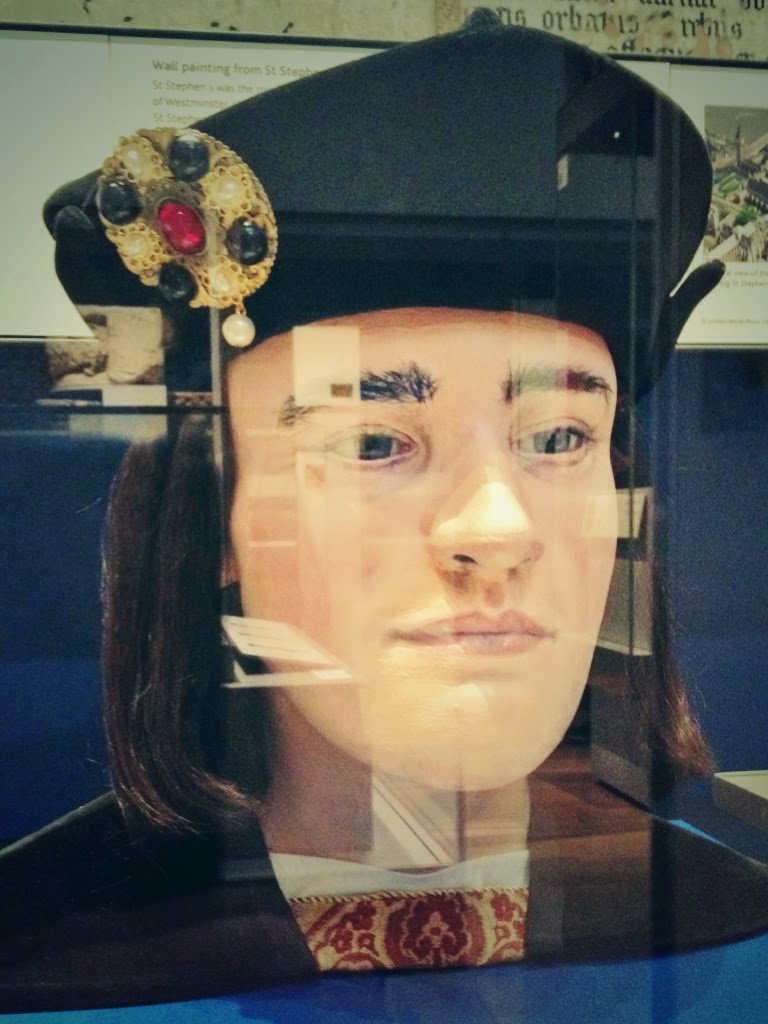
It is hardly on the scale of the fantastic find in Leicester of the earthly remains of King Richard III, but mysterious bones have been uncovered at Rochester Cathedral.

The excavation site
A Heritage Lottery grant, along with privately raised funds, is currently providing the finance for a new project to renovate the crypt at Rochester.  At the moment the crypt is an empty, echoing space with a couple of chapels, one enclosed behind glass and impressive wrought ironwork, but it feels very much a utilitarian part of the cathedral, made more so by the small kitchenette in one corner to provide teas for the choir between practice and services.  The project intends to breathe new life into the somewhat dark and dingy area and transform it into a permanent exhibition space with new displays including the unique and extremely valuable Textus Roffensis.  More on that next week.

Part of these works has involved digging a trench outside the crypt on the north side of the cathedral, alongside the presbytery.  This is to enable more toilets to be built and connected to the sewer system.  So far, so suitably undignified.  During these excavation works the contractors came upon a large number of bones, an event which was entirely unexpected.  According to the, albeit sketchy, records for the cathedral, there are not supposed to be burials here.  There is a lay cemetery on the north side stretching from the nave transept to the west front along the length of the nave, and it was thought that the monastic burial ground was closer to this.

This old photo shows the area
without the modern walls

The bones could be monastic, the bodies of the monks who lived and served at the cathedral over the centuries.  They could also be lay people, those who lived in the town and were suitably wealthy to be interred so close to the cathedral.  Unless substantial complete skeletons are recovered, which I do not believe to be the case, it will probably be impossible to tell.  A full skeleton, or near complete set of bones can tell you how the person lived, diseases they may have suffered from and analysis of their bones and teeth can show the kind of diet they would have had. 

The shadow of Richard III
The fragments that I saw being removed from the trench are small and broken.  They will never be identified and, even as anonymous fragments, they will be treated with the utmost dignity fully in compliance with Church of England advice.  I wonder that a handful of unnamed bones of indeterminate age and sex will receive more tender care than a king who still resides in a cardboard box in a lab.

I was told by the contractors on the site that as they uncovered the bones they were put to one side and when an appreciable amount was collected the clergy would come out of the cathedral in full regalia to reclaim them and take them back into the cathedral.  I don't know where they all are now, however, what I do know is that they will all be reinterred as close as possible to where they were found, the same place if possible and in the presence of the clergy.  Some have already been laid back to rest, their ground not earmarked for more interference, but there are some still waiting to be returned once the building work has been completed.

Monk, or merchant?
The discovery of the bones of Richard III in 2012 has caused a great many people to re-evaluate how they feel about the disturbance of a grave, certainly not least myself.  I studied archaeology and digging up bones was part and parcel of investigating barrows and burial pits, cists and sarcophagi.  But it is so easy to lose sight of them as people.  Richard III brought that message crashing down on us - you put a name to the bones and suddenly they become a flesh and blood person with thoughts, feelings and family.  These bones were people, merchants maybe, seamstresses, inn keepers, squires, sailors, monks.  We will probably never know for sure unless we find a document stating who was buried here but we can be fairly certain that they were all loved and cherished to be where they were.  They were disturbed by accident, not from some pre-planned excavation looking to retrieve them.  Somehow that makes a difference.  It is less mercenary.  And it does seem rather fitting that they were discovered during a project to bring better understanding of the cathedral and its place in the world to a wider audience.  By finding a new burial site we have furthered our knowledge of the cathedral and its wider community.


Thursday, 10 April 2014

My favourite Holy Roman Emperor: Charles IV of Bohemia

Charles
I didn't know Charles existed until last year.  There, I've admitted it.  And I found him quite by accident.

Having driven past signs to Crécy on holiday I became intrigued.  I was a devoted Normans and Angevins fan and never really showed any great interest beyond Edward I and his domestic wars.  I had touched on Edward III but only as far as society was concerned, not politics. And so I embarked on a personal project to learn about Edward and Crécy.

No fewer than five kings took to that field in northern France, and one was slain - not the king of France, or even of England, but Bohemia.  I had to find out what a Bohemian king - a blind one at that - was doing fighting in a battle between France and England.  And during that search I discovered that this king had a son.  Charles.

The outline of his life is, in a nutshell - born 14th May 1316, a boy removed from his homeland to be brought up in what was his extended family at the court of the French king.  He was sent to fight in Italy and then re-established the role of the monarchy in Bohemia.  After arguing with his father they then reconciled and were together frequently around Europe, culminating in Charles election as king of the Romans, (i.e. Germany) and in the Battle of Crécy a couple of months later, where John was killed.  Charles became king of Bohemia, won around his opponents to gain complete control over the Holy Roman Empire, made Prague its capital and personally ruled half of Europe.  He married four times and died from pneumonia on 29th November 1378.

But that really doesn't tell you much about the man. 

Charles was reckoned handsome, above average height for the age, golden haired in his youth darkening to brown by middle age, with large brown eyes and a delicate nose.  He must have looked rather exotic and along with his wealth and status explains his popularity with the ladies of Lucca in Italy.  He talks in his autobiography of enjoying the charms on offer in Lucca, but by the time he was writing he expressed regret over his behaviour.


Charles and Anna, his third wife
Charles had four wives. Yes, FOUR wives.  It sounds excessive but Blanche, his first wife, to whom he was reputedly devoted, died suddenly in 1348.  His second wife Anne died after three years of marriage, in child birth.  His third wife Anna lived longer and was the first queen of Bohemia to be crowned empress. She had been betrothed to his son Václav but Václav died aged just eleven months old and when his second wife Anne died he married Anna himself.   She was just fourteen and he was thirty-seven.  She gave Charles the son he craved but she died aged twenty-three, again in childbirth.  Only his fourth wife Elizabeth outlived him.  

Against the accepted norm of the age, Charles appears to have been faithful to his wives, once he left Italy and began to live with Blanche as her husband, that is.  There is just one attributed illegitimate child, a son called Vilem who is mentioned in a single source in 1377.  No more is known about him, not even his age in 1377 so there is no way to tie him down to a time in Charles' life.  So there is no evidence to suggest he was conceived while Charles was married.  My personal opinion tends towards thinking that Vilem was the result of a union between Charles and some lady who offered him comfort after Blanche died.  Fanciful maybe, but as he became more and more detached as he grew older, it seems unlikely that he sought out a romantic entanglement.

His increasing detachment from people encroached on his personal life.  There is a poignant tale told about his second wife Anne.  Generally held to be bright and intelligent, she felt neglected by Charles, and prepared a love potion to lure him to her.  It nearly killed him.

His fourth wife also had cause to feel aggrieved.  Elizabeth of Pomerania was a rather comical woman.  Her party piece performed at banquets was to bend pieces of iron such as bars and horse shoes with her bare hands.  They had children, including two sons but, although she and Charles rubbed along together well enough he favoured his children by earlier marriages.  She outlived him and despite her complaints appears to have been fond of him and requested that she be buried beside him.

Young Charles
His health suffered later in life. By his later years Charles was still quick witted and affable but he was not warm.  He avoided making eye contact with people and preferred to whittle at a piece of wood with a knife than to engage.  He did what he had to but appears to have taken little joy in it.  He had been injured numerous times, including at Crécy.  One of these injuries was to his neck which probably broke a vertebra causing him to stoop.  He suffered from gout and found riding uncomfortable and travelled in a litter.  Finally he fell and broke his leg causing him to be bedridden.  And thus he died from pneumonia.

I have saved my favourite story for last.  In 1348, the year when Europe was first beset by the Black Death, Pope Clement VI had cause to berate Charles.  He told the emperor to dress more modestly.  Apparently Charles was something of a dedicated follower of fashion and favoured the new taste for extremely short tunics.  He shocked not just the pope but the people of Prague because he showed an immodest amount of leg.  So shocking was this deemed to be, over a hundred years later Pope Pius II wrote that Charles had not dressed properly.


And that is the image I leave you with - a handsome, exotic, young man with long brown hair, large eyes and a delicate nose; the most powerful man in Europe who dressed in a scandalously short tunic with too much finely shaped leg on show.

Thursday, 3 April 2014

The Ghost in the Machine

Continuing my account of growing up in Rochester cathedral in Kent, England.

The organ blower, in its dim little room in the crypt of Rochester cathedral, was always breaking down.  It was old, temperamental, and had a mind of its own.  That was the rational explanation.  The less rational version of events, which somehow seemed far more likely to those of us who had spent so much time in it, under it and around it, was that it was haunted.  There is a list of the former choir masters and organists of Rochester cathedral on a panel next to the door to the organ loft under the quire screen.  I often looked at that list and wondered which was responsible for what went on with the blower, and indeed, the organ itself.

Area of the crypt where the organ blower 
room was, through arch to the right. 
The wall to the left is a 'false' wall.

The blower's party piece was to shut down during a musical service.  It was a very noisy piece of machinery, even up in the quire you could feel there was a constant rumbling when it was switched on and the sound of air being forced into the wheezing bellows located behind the organ console was always in the background.  So when it was switched off, you knew.  On one occasion when I was sitting out a service in the organ loft, the blower switched itself off.  The choir master rushed down to the blower room to see if there was anything he could do, but had to return to conduct the now a capella version of the anthem as the organ was utterly dead.  Professionals that they were, the choir coped without a raised eyebrow.  Once freed by the sermon, the choir master climbed back up the narrow steps to the organ loft to continue pushing buttons and trying again and again to restart the blower with no success.  Then, with no warning, it burst back into life, all on its own.  Neither the choir nor the congregation were particularly surprised.  They were so used to the blower and its foibles that it was just another day at Rochester cathedral.

There was another incident, recounted to me by one of the organ scholars.  The scholars were generally young musical genii taking a year out of university to study church music in its natural environment.  They were creative and some were more whimsical than others.  This particular one was bright, intelligent and perfectly down to earth.  He headed out quite late one evening, he explained, leaving the house he occupied on Minor Canon Row to walk around the cathedral to the Gundulf tower which was the only out of hours access to the building.  As he walked he heard the unmistakable sound of someone playing the organ.  He wondered who it could be because he was scheduled to practice that night, so no one else should have been there.  He had the choir master's keys himself, so who was it?  He was rather agitated as they were using his time and he hastened around the west front.

Rochester cathedral west front

He unlocked the gate in the outer wall of the little courtyard outside the Gundulf tower, which he thought unusual as it was normally secured by the last person to leave.  He then unlocked the heavy wooden door into the tower itself.  The organ was still playing and the student's feet sped up, anxious now to find out who was in there.  He hurried through the little stone corridor that links the tower to the cathedral proper and opened the door at the end, again, usually left open, and walked around the corner, up the stone steps to the quire screen and to the door of the organ loft.  The organ fell silent.  The door was locked.  The organ loft was empty.  The silence was utter.  Not even the bellows gushed air as they settled, as they should have, had the blower just been switched off.  He left again, he told me, far more rapidly than he had arrived.

Big, old buildings filled with history and dead people should by rights always feel as if they are haunted, especially at night.  The dark should hold menace.  The lamp posts throwing weak light through the stained glass windows should chase shadows across the stone floor.  But the cathedral isn't like that.  Maybe because I knew it so well, maybe because I really did know it with my eyes closed, and in total darkness, I never felt anything sinister there.  If it was truly haunted it was by those who couldn't bear to leave this remarkable foundation.  I was there in the middle of the night on more than one occasion.  My parents were called upon whenever the organ blower gave up, and if that was at midnight, then so be it.  I would be roused from my bed, made to dress and trek down to the cathedral so my parents could fix whatever had gone wrong this time.  The empty, silent church became a playground.  The only lights were those we needed to navigate from the Gundulf tower to the crypt entrance on the other side of the nave.  The rest was left unlit.  No one would hear us, no one would see us, and there was no limit on the places my brother and I could go.   Yes, it was cold more often than not, and going to the loo was a chilly and sometimes chilling experience as the only loos were in an uncovered gap beside the Gundulf tower, effectually outside and filled with spiders.

The organ. The case was designed
by Sir George Gilbert Scott

The organ underwent a major renovation and rebuild in 1989 and part of that was to replace the blower.  I was lucky enough to work on this rebuild, though I suspect that my electrical work behind the console was replaced in 2006 when the electrics were further upgraded.  I, of course, got to scamper up the scaffolding that reached up giving access to both the organ front and the crossing roof so it could also undergo renovation.  The new blower was relocated and the old blower room finally opened back up to the public.  The stonework here still retains its dark, mouldy hue from being enclosed for so long.  I heard no more of the supernatural goings on, so maybe the modern organ is too complex for the ghostly organist to manage.

The cathedral still holds secrets that are thrown up when they are least expected.  There is a chair store that reaches under the cemetery to the north of the cathedral and during work to underpin it several lead coffins were found.  The archaeologists told them to put them right back again and not to attempt to open them.  We always knew the crypt extended further back than the white washed wall to the west.  There is, behind the wall, an enormous pipe that fed air to the organ from the blower, big enough to crawl through.   In this space it is rumoured that a member of the Dracule family was laid to rest, the same family that fed the Dracula legend.  A lottery heritage grant is opening this area up, the wall being knocked through, so maybe we will finally discover if this is true.  Above in the nave is a large, enigmatic stone on which is carved the words 'Entrance to the Vault' but this vault has never been located, even using geophys equipment.  I know what used to be kept behind the high altar!

At the time I saw little strange in my unconventional childhood - it was just how it was.  The cathedral and the community were an integral part of my life.  My headmistress was a steward at the cathedral and had known me since I was a baby.  She requested that I attend her school.  My RE teacher was married to a Canon and had also known me most of my life.  When 'Songs of Praise' came it was natural that we all sat in the front.  I didn't really understand the awe from my fellow students on Diocesan singing courses when I had to reply to the question 'Which church are you from?' with 'The Cathedral.'

I didn't think I'd miss it.  But now when I go back it feels different, like visiting an aged relative you haven't seen for some time who no longer quite remembers you.  The stage is the same but the players are all different and a new story is being acted out.  My small part in the history of this great place has come to an end.  Now I am merely a spectator.  But I have my memories and that won't ever change, rather like the cathedral itself.