Friday, 4 November 2016

Books of Power

I happened upon a blog post this week via Twitter, which I find to be an Aladdin's Cave of tidbits and gems that you would otherwise never know existed had someone else not re-tweeted them. And this post really got me thinking. You can find it here and do please have a look.

Library at Trinity, Dublin.
This is how I envisage the Library of Babel.
Borges' version has hexagonal galleries.

If you don't have time now, that's fine but do come back. The writer of this post, Chris Rose, chooses five books that have had the most influence on him.

For a reader that is an enticing thought - which, of all the books I have ever read, have had the most influence on me?

When I started to think about this, I wanted to qualify that phrase 'influence on me'. In what way? Influenced me to write? To read more? To research? Or just one that remains with me, a favourite?

If I were to choose my favourite books, they would probably include some of the same in this list, but there would be differences. I admit that at least one of the books on my own personal 'influence' list would not necessarily make it to my desert island with me. And there are those that I would have with me on the golden sands under the white heat of the sun that I wouldn't say influenced me.

So, what did I pick to be on my list? I have to warn you that you won't find any classics here, and probably only one of these would ever make it onto a list of required reading. But what influences us need not be high brow, literary and intellectual, but can be more humble and have no motive other than to entertain.

And so, here goes, and in no particular order:

The Wild Hunt by Elizabeth Chadwick

This novel more than any other showed me that it was possible for a medieval romance to be more than ripped bodices and hysteria. The melodrama in most historical romances that I had read up to finding this novel was overwhelming, and they were filled with over-the-top characters who could not decide if they wanted to be strong and in charge or happy to swoon in front of the handsome man. The characters in this novel behaved rationally and were somehow more serene and yet still vital and engaging. This first published novel by Chadwick was an eye-opener.

Fictions by Jorge Luis Borges

This volume of short stories I read in Spanish and actually I never did get round to reading it in English. I have two volumes of his, but most of the stories I like are in this one.

'The Library of Babel' discusses the existence of an eternal and infinite library in which there is one volume each of every possible combination of letters, so it will include the works of Jane Austen, Shakespeare, Cervantes, and yet it will have a volume that is entirely devoid of print. And another with just one letter, and another with just one letter, but on a different page.

'Pierre Menard, the Author of the Quixote' is rather bizarre but I think it should be required reading. The story is a critique on two books - 'Don Quixote' by Cervantes and 'Don Quixote' by Pierre Menard, a modern writer who set out to write Don Quixote and wrote an identical book to that of Cervantes. But the critic reads the two volumes differently. He likes Cervantes' version, it is true to his time and he believes what he writes. However, the Menard version, a word-for-word reconstruction, is full of affectation and anachronism and yet its ambiguity renders it richer than Cervantes' version. 

The story's intention is to explain that you have to take into account the motive and mindset of the writer to understand and appreciate the writing. It explains why 'Carry On' films are still so funny and yet so very un-PC, and why the newest version, 'Carry On Columbus', didn't work although we still laugh uproariously at 'Carry On Up The Khyber' and 'Carry On Doctor'. 'Columbus' was inescapably a product of its time, and time had moved on.

The Fifth Quarter by Kim Chesher

I salute you if you have heard of this. I really do! I found this in my school library and I was addicted. I photocopied a version I asked the local library to find me some years later so I could keep it as it was many years out of print, and then I managed to obtain a copy through Amazon Marketplace. So I am now legal!

This book was written for teens but don't let that put you off, it is well written and sensitively written. There is only one glaring error, but I am happy to overlook it. I won't tell you what, find a copy and read it for yourself. It introduced me to smugglers on Romney Marsh and the 'what if' of history. Now we know what happened to the Dauphin during the French Revolution, remains have been found and DNA used to identify them. He was likely murdered, certainly he died. But when this novel was written that wasn't known, and it was quite possible to imagine that he turned up on Romney Marsh. The title of the novel comes from the belief that there were four quarters of the Earth, and then Romney Marsh, the fifth quarter.

Brother Cadfael's Penance by Ellis Peters

All the Brother Cadfael books are brilliant. So to choose just one should be tricky. But it isn't. This particular volume is a little different from the others. Cadfael leaves the enclave of Shrewsbury, where most of the other books take place, to seek out his son who has fallen into the hands of an enemy, Philip FitzRobert, one who had been his friend. It isn't the story as such, although it is an absolute delight and is a sequel to my other favourite, The 'Virgin In The Ice', but it is the stunning narrative, the descriptive passages, particularly how she portrays this enemy of Cadfael's son Olivier. They are mostly single sentences that are so carefully structured that they illuminate his character more perfectly than another author could do with a whole page. Whenever I am at a loss I turn to this novel and I always find inspiration. If I could write like anyone who has ever put pen to paper, it would be Ellis Peters.

And finally....

Here Be Dragons by Sharon Penman
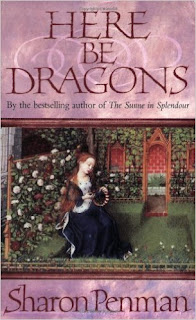
This was not the first of her novels that I read, that honour goes to 'The Sunne in Splendour', the longest novel I have ever read and the only one I have ever fetched from the library in hardback whilst owning the softback because of the sheer size of it had to be seen to be believed.

No, this was not vast in size, but it was vast in its effect on me. For this one single book was the sole reason for my choice of university.

This is the story of Llywelyn Fawr, a Welsh Prince who is one of those wonderful characters who lived a life less ordinary. For me, Penman's portrayal will always be the real Llywelyn. Even after having studied him under the two most eminent Welsh history professors of their (and my) time. I knew nothing of the history of Wales before this and studying at the only Welsh History department in the UK merely filled in the gaps, so thorough was Penman's research and writing. Strangely enough 'The Reckoning', the novel she wrote about Llywelyn the Last, Llywelyn Fawr's grandson, didn't have such a lasting impression, although the man himself did.

As I said earlier, these may not necessarily count as my favourite books (Cadfael has been read too many times to be counted, as has The Fifth Quarter) but however much I like 'Pride and Prejudice' or the character of Anne Elliott in 'Persuasion', they haven't changed me. I suppose my soul is richer for having read them, but they didn't alter my trajectory or change my understanding of the world as these books have.

Now I've told you mine, tell me about yours. What books set you on a different path? Which writer changed your life?

Friday, 28 October 2016

When is a henge not a henge?


Civilisation 6 came out about a week ago. Civ, as it is known, has a massive following because it is the most sophisticated game of its type. Yes, you wage war with archers, cannon and nuclear weapons, but you can also win a diplomatic victory, seal trade agreements, found religions, cultures and Wonders.

One of these wonders is a henge. And that is where the confusion starts.

Because when we hear the word 'henge' we automatically think of Stonehenge. I mean, why wouldn't we, it has the word 'henge' in it after all. 

And yet, it isn't a henge.

Confused? I'm not surprised.

OK - this is really simple.

A henge is a prehistoric monument created for ritual purposes, and as if to underline these ritualistic motives, it is purposely built the wrong way round.

Think on this - you build an earthwork structure to defend yourself. You want to make life as difficult as you can for an attacker. So, you build a ditch and a bank. Defensively you build the ditch on the outside, and the bank inside because then any attacker coming from outside has to descend the ditch and then scale the bank.

Let's say you dig a ditch around the outside of your settlement to a depth of 2m. The spoil goes inside the ditch, into your settlement, and you use it to create a bank. Anyone attacking you faces a ditch and a bank. The ditch is 2 metres deep. The bank is 2 metres high. That is a combined difference of 4 metres: 2 metres down, climb back up those same 2 metres, and then scale a bank of 2 metres. That's defensive.


Now reverse that. You build a monument. You build a ditch 2 metres deep. You use the spoil to build a bank, outside the ditch. Anyone coming to your monument goes up a bank of 2 metres. Then they descend 4 metres, easy, and then up another 2 metres. The downward run would carry them most of the way up the 2 metres bank. Not defensive. 


So, a henge is a reverse of a defensive ditch earthwork.

And just to be sure, let's have a look at first Stonehenge:


And now Avebury, a true hengiform monument: 


See the difference?

Now you know conclusively what a henge is.

Sunday, 16 October 2016

Memories - the true archives of History


The life of the dead is placed in the memory of the living – Cicero (106 – 43 BC)


What are your earliest memories? What are they about? Are you three or four years old? Are you on holiday by the seaside, with a grandparent, long passed?  Or at school? We all have memories of childhood, some bad, mostly good, I hope. Mine are. Our memories are our sense of self, the who, the what, the why and the when.  Without memories we would never pass exams at school, we’d forget friends' birthdays, family events, we wouldn’t be popular! And we wouldn’t know who we are.

We have different kinds of memory, long term, short term. Our memory works in very odd ways. We have a momentary memory – that ability to look at your watch, process what it means to you, and then have to look five seconds later when someone asks for the time. And yet we can still recall moments, textures, sounds and smells from the very beginning of our lives, which for some of us are longer ago than others. I walk into a room and forget why I was there, yet I can recall the moment at two years of age that I dropped a cup of scalding coffee down my front.

But what are memories? Where are they collected and stored? In our heads, yes, in our brains. In the limbic system, our mammalian brain near the olfactory lobe, linking memory and smell and emotion so very closely, and all controlled by the neocortex. But is that all?

DNA strands
Doctors don’t actually understand memory. They can say that here and here are where in the brain memory is stored, but they cannot say for certain. In some people memories have been lost due to damage to the brain material through injury of one kind of another and when other parts of the brain are stimulated, parts that are not thought to have anything to do with memory storage, memories return. So if memories can be stored in possibly an infinite number of places in the brain, why not other parts of the body?

OK – this sounds a bit weird, but let’s think about this.  The blueprint for everything we are, hair colour, eye colour, height, weight, every detail, is DNA.  And if we are our memories, why could DNA not store memory?

Tybalt and Mercutio face up in
Romeo and Juliet, photo by
Dee Conway for ROH
People talk of collective memory, a group of people, communities, nations, who all feel the same way, act the same way under a given set of circumstances. Is that passed on in DNA through families? Is this why some family feuds won’t die, the Capulets and the Montagues? Could long-held prejudices also be passed down, through this collective DNA memory - the age-old dislike that persists between the French and English? How often have you heard the phrase ‘It’s in our DNA’?

When we have children they have DNA from both the mother and the father. That could mean that every child has a collection of memories passed on through both sides of their family. Everything that ever was in that bloodline is distilled into each child, and they in turn pass that on.

Now, I’m not talking about solid exam-passing memory here, but the fleeting kind, the dream that leaves little more than a feeling and sense of maybe what was. It makes sense that this memory, this feeling, could direct our actions, our likes, dislikes, career choices.  It could be that someone who loves Romans had an ancestor who had a really good life as a Roman and the memory that persists from then is stronger for it and lingers. It could therefore be that someone who has no particular liking for history but maybe science, may find an ancestor for whom science was a passion, or who liked to understand how the world works. The setting was not important, only the substance.

But if we DO carry memory in the DNA, doesn’t this explain past life regression? We haven’t ‘lived’ before, we are recalling lives lived in the past, the details of which are merely more vividly recalled. Just as sometimes that dream doesn’t fade but remains as clear as a movie, in glorious Technicolor and surround sound.

William the Conqueror, medieval
Marmite - love him or hate him?
For us history people it could explain why some people are passionate about certain eras and with a certain lack of logic, loathe certain people from history.  Maybe someone who hates William the Conqueror has an ancestor who faced him at Hastings. Or someone who adores King John had a relative who was on the receiving end of his lesser known but equally powerful generosity.

Take me – from family legend and my family name, we came from Brittany and first came to England in 1066 in the company of Count Alan. If this is the case then it is pretty fair to say that until we left to travel to war, we lived in Brittany and probably didn’t stray too far, meaning that we would have always have been Bretons. Which could take us as far back as the era of Vercingetorix. And if an ancestor had lived through that rebellion, that would be a perfect cause for hating the Romans, and yet maybe loving the beauty of Rome the city, a place that would be an unimaginable futuristic fantasy for a rural Breton captured and brought to Rome. Such traumatic and pivotal events would leave a trace.  And if the men of the family did cross to England with Count Alan, chances are they were excited about going on an adventure, relieved to have won against the barbaric Anglo Saxons, delighted to receive rewards from their master, all good reasons to feel pleased with themselves.

A gallant King Edward III
And all this may explain why I was utterly enthralled when I began to investigate the king who fought and won at Crécy. Did an ancestor know Edward III? Did they fight on the Crécy campaign under his command, a sailor at Sluys maybe, or merely an admiring lady at whom he may once have bestowed a fleeting smile that meant little to him, and all to her? (Perhaps this explains my intense distaste for Alice Perrers). Maybe it is merely because, as Dr Ian Mortimer holds, if you can trace your family back to England before the steam train allowed widespread travel options and migration around the country, you are around 80 - 95% likely to be a descendant of Edward III. That is a beguiling thought.

We don’t have strong feelings for all eras and times, just some - a love of Anglo Saxons, and a detestation of Victorians, but maybe Queen Anne leaves us feeling, well, nothing really. And I would like to hypothesise that the reason for this is that, as we do in our own lives, we forget the boring and uneventful, and recall just one or two, maybe three major events from the past  which were memorable, for good or bad reasons. We may be predisposed as humans to forget pain – and thus allow us ladies to have more than one child – but the fear is there, and that is not forgotten. But the mundane, the average, the tedious, that passes quickly from memory and we dwell either on the very bad or the good. And so it may be with DNA memory.

Queen, err, who? Oh,
yes,Queen Anne
Another aspect to this subject to consider is instinct. Instinct is passed on from mother to child, and that must be housed in DNA. Instinct tells the heart to start beating. Instinct tells a baby to breathe when it is born. Instinct tells a calf it has to stand shortly after. No one teaches this behaviour, it is natural, and through evolution, passed from one animal on to the next and to the next.  Instinct comes from a behaviour that was exhibited by one animal that gave it an advantage over another and was thus passed on because that animal survived, when the other did not. That is evolution.  And so is instinct, therefore, any more than a memory? And if instinct is stored in DNA (how else can any animal act before it can communicate?) why then should not memories of the lives, loves, likes and dislikes, of our ancestors also be encapsulated in DNA?

But, I hear you cry, why don’t we have identical feelings on subjects to our parents and our siblings, cousins, aunts? If we share a collective memory, why do we not feel the same way? Well, one explanation is that we all remember things differently – you can ask ten people who saw the same event what they saw and get ten differing versions. We each have a personality and we each will place more or less weight on different things. And maybe we treasure different memories, value different aspects of it. Maybe our upbringing influences what we recall, what we pay attention to and what we ignore.

Until scientists can pinpoint exactly where in our bodies we store memories, the theory that it is stored in our DNA can’t be disproved. And if instinct can direct our actions so forcefully, why cannot these other DNA memories make us like, love or loathe?

Now, where did I leave my crown?


Friday, 13 May 2016

Edward III – the Perfect Leader?


I need little excuse to extol the many virtues of Edward III, I really don’t.  But I was rather surprised when I researched for my day job into the topic of leadership skills and came to the conclusion that if you need an example of a great leader, Edward fulfils almost every criteria, constraints of Medieval technology and lack of email allowing.

I was looking into the subject of what makes a great leader and if you look on the internet there are lists and lists and lists of attributes that people believe makes one a good leader.  It appears to depend very much on who you ask what the answer to the question of ‘what makes a leader?’ turns out to be, if the respondent is a leader themselves, a subordinate or the boss of a leader, and yes, leaders do have bosses.  What the board are looking for in appointing a new leader is very different to what those who report to a leader want to see.

There are common themes however, that all agree to varying degrees.  Leaders communicate well.  They develop people.  They allow others to take the credit. They lead by example.  Leaders also inspire, are charismatic, are excellent at managing people.  They have clear foresight. They innovate and they see beyond themselves and strive for something greater than they are.

So what does all this look like in practice?  Well, that is really easy – just look at Edward.

Communication – well, this is not the easiest to deal with so let’s get it out of the way first. Communication in Medieval Europe was not what it is now.  Communicating with someone in southern France could take months. Now it takes as long as it takes you to write an email and hit the Send button.  So to what extent can we say Edward was a great communicator?  Did he communicate?

He could read and write, and he used communiqués for his own uses, and he used his own code.  Between 1327 and 1330 when he was under virtual house arrest, he added a line of text, ‘Pater Sancte,’ to those letters to the pope that were directly from him and not from Roger Mortimer. These letters are in the papal archives still.

Edward's code clearly visible in an unprofessional hand, beneath the formal, neat and even official script
He certainly understood the value of communication and he understood the need to standardise language. He decreed in 1362 that English should be the language of Law instead of French to that the average non-French speaking Englishman could understand the law.

Battle of Sluys from Froissart
Develop people / allow others to take credit – this is an area in which Edward excelled.  A great leader will collect together a pool of talent to get things done. Churchill did this with his wartime 
coalition government drawing on the best of all parties. Edward did the same thing.  He used talent where he found it. He was wise enough to know where he had skill gaps and he filled them where he could.  In 1333 the notorious pirate John Crabbe was captured in Berwick having fought on the behalf of the Scots.  He had a long history of pillaging and plundering on the high seas, and the lower ones far closer to the English coast, and harrying English merchants, murdering their crew and stealing their cargo. Edward II sent many letters demanding restitution from the count of Flanders who was assumed to be directing his actions.  However, despite having very much deserved it, Edward did not hang him.  Edward was just twenty at the time, but he was already aware that John Crabbe could be useful.  So he paid his gaoler Walter Manny £1000 for his custody and promptly pardoned him and brought him into his household.  He managed castles, prisoners, ships, archers, anything that needed to be done that he could do he did, including using his knowledge of sailing at the battle of Sluys in 1340.

Similar was the fate of one Aimeric de Pavia, a Genoese soldier and sailor who survived the siege of Calais on the French side but served Edward for the rest of his life as captain of the king’s galleys.  When the famous knight Geoffrey de Charny contacted de Pavia in 1348 to bribe him to hand over Calais, Aimeric appeared to accept but sent word straight to Edward allowing him to launch an ambush on the Frenchman and saved Calais.  Aimeric sadly paid for this act with his life.  A few years later de Charny captured him and hanged him.

Here Geoffrey de Charny, left, confronts
Edward, in the red with lions, fighting
under the banner of Walter Manny
That ambush at Calais illustrates another point about Edward, how he was happy to let others take the credit. He and his son Edward of Woodstock, later the Black Prince, travelled to Calais to counter the de Charny threat, with several men and soldiers, in disguise as merchants.  Edward was very much in command.  However, once the fighting started he joined the fray, not under his own banner, but under Walter Manny’s.  It was something he often did in tournaments and games, rather than fight under his own colours, he would join the ranks of one of his friends.

Lead by example – this one is easy – he fought with his armies as was expected of a king of those times.  He fought personally at Sluys and was wounded in the leg, immobilising him for two weeks and ruining a pair of boots.  He probably saw little fighting himself at Crecy but at the crossing of the Somme it was he who personally managed the crossing of the baggage train while others fought the French on the other side of the river.  He was in reserve at Crecy itself, but his son was in the vanguard so it was obvious to all that he had invested a great deal in the battle.  He fought personally at Winchelsea and nearly drowned when his ship was sunk under him.  As we have already seen, he fought at Calais. 

Fascinating 3D scans of the tunnels under
Nottingham castle leading into the town
I really don’t need to go into how he inspired his men or how charismatic he was.  People liked him.  His wife was dippy about him: an anecdote included by Froissart that must have come from her or someone close to her spoke of how she cried when he had to leave after they met for the first time, in Hainault.  In 1330 it was not Edward himself who captured Mortimer, but his friends who had entered Nottingham Castle via secret passages – and they did it solely for him.  Mortimer was an able administrator and those who served Edward himself would have done perfectly well without Edward, but they chose to first put themselves in danger in front of Mortimer when he confronted a suspected plot and then to act directly against him.  Back to Calais in 1349 he only had to lift his helm from his head and show his face to  make others fight for him and to discourage the French from fighting against him.

Foresight and innovation – Edward again had these qualities in spades.  In wartime he saw the potential of archers.  The strength of an archer lay in their ability to attack from a safe distance – projectile warfare.  Yes, the famous Genoese crossbowmen also did this, and from the behind the safety of their pavisses.   But although they had a similar range, possibly a slightly longer range, they were slow to reload.  They were utterly out-gunned by the English.

Another of Edward’s wartime innovations were cannon and ribalds.  There is debate over how effective these weapons actually were, if they did more than merely make a bit of a racket, but I believe that is beside the point.  They were there, for the first time, at Crecy under the command of Edward.  Someone had to do it, had to try, and it was him.  As they say, a good plan executed today is better than a perfect plan executed next week.

In peacetime he innovated as well.  He owned a clock just a few years after they were perfected in Italy. He had hot and cold running water at three of his palaces.

By whatever criteria you wish to use, Edward measures up pretty well if not excellently.  Sadly we do not have enough of his personal thoughts and feelings and the detail that we have for more recent leaders to judge if he consciously tried to be a great leader or whether he was a lucky combination of genes.  Can he then further the understanding of whether a leader is truly born or if it is a skill that can be learned? Considering how his father embodied a great number of behaviours of poor leadership regardless of whether he was a good man or not, which is not under discussion here, does not help – was Edward acting deliberately, or was he just a natural where his father was just not? 

An unusually flattering image of Edward I, but
was he really a 'git'?!
Edward I, his grandfather, is accepted as being a great leader, who displayed many of the skills that his grandson was to, but he was rather insular in his thoughts and his actions were motivated more by personal ego than the greater good. In a seminar session in my third year at uni a fellow student shocked the modern historians present with her judgement on Edward I – that he did what he did because he was, and I quote dear Amelia, ‘a git.’  Whatever motive Edward III had for going to war, the country benefited.  His decisions were designed for the benefit of England, and not solely himself. 

Let’s have a look at two of those now.

Edward went to war with France because he claimed he was the rightful heir.  That the French changed the law to prevent him inheriting suggests that he was onto something.  But, as kings of England before him had, he owed fealty for lands held in France, left-overs of the Angevin Empire.  He was therefore subordinate to the French king, and if that is extrapolated, so was England. Philip VI even made comments to this effect. So, Edward claimed the throne through his mother and as a declared claimant he could not be subordinate to the French king for lands that he held in France. He elevated himself from a mere disruptive vassal to an equal. England was taken entirely out of the equation, as was any land he held in France, such as Calais that he declared was not part of any discussion while he laid siege to it. Clever.

Another of his actions was the sumptuary laws.  It was Edward who declared that certain strata of society should not wear certain fabrics.  It was not a status-based law but a monetary-based one, designed so that overly-competitive merchants or others would not bankrupt themselves and their families in competing with the Jones family across the way.  Seen as a way of constraining lower social classes, it was meant as a protective measure – if you could afford it, great; if not, don’t.  Sound advice, even now.  I have not done any research into this particular area but laws designed to limit a person’s ability to bankrupt themselves, and their families, through unwise expenditure, was also being examined in Bohemia at the same time. Was this a mid-fourteenth century concern or a happy coincidence?

So, can we answer the question of whether leaders are born of created, just by looking at Edward?  He seems to be a little of both.  His abilities had to have been innate to be so well honed at such a young age.  Such perfection cannot be learned, not in the toxic atmosphere that Edward found himself in as a teenager.  Had he turned out to be a tyrant there would have been little surprise.  And some of it had to be a reaction to seeing what the consequences were of getting it so badly wrong, having witnessed everything that had happened to his father.  A lesser man with less support would have allowed the likes of Mortimer to continue, using it as a fabulous excuse for inaction.  But that was not what Edward was.  For the measures taken by Mortimer and Isabella in those last few months, Edward’s mother taking personal hold of the keys to Nottingham castle, Mortimer’s questioning of Edward’s household in front of him that sparked the whole rebellion, suggest very much that Edward was not to be trifled with, suggest that the ruling couple had good reason for their caution.

Edward was not perfect. No one is.  Much of what he did is held up to criticism, and probably rightly so. Remember, however, that the great Winston Churchill was voted out of government twice in his illustrious career and at one time Nelson Mandela believed that violence was a legitimate form of protest. Imperfections and failures can make a person a great success.

Born or created, it doesn't really matter. A great leader is a great leader, whether they are naturals or strive to overcome their own personal shortcomings. That the best turned their talents to the greater good makes them more extraordinary. And for Edward to embody all of this makes him exceptional.

Sunday, 14 February 2016

Dreams, Passions and Regrets

So, here's the news. I'm dancing again!

I said I'd come back. I have done too much to give up. Not now. Not yet.

I have been going to an adult class run by my usual ballet school filled with people I know and it is enormous fun and hugely satisfying. I come back from class with a huge grin on my face, hot and sweaty and happy. My husband says I skip into the house; Junice, my former teacher, says I have a look that says "I'm back!".

The class teacher is new to me, and that in itself throws up challenges. She doesn't teach my syllabus, so I have to think far more on my pointes than I have for some time, and she teaches what I refer to as 'performance' ballet, not 'class' ballet. And with a French flair, not the Italian, Cecchetti precision I have become accustomed to. I find myself pushing my Cecchetti to the back of my head and trying to drag the French that I consigned there to the fore, and not always that successfully either. So I end up translating in my head, where there is a translation!

Going back to class, and an interesting blog I found from a lady in Australia all about adult ballet (Zoe Does Ballet), got me thinking about my dancing.  

Marianela Nuñez


Let me get one thing clear - I am not an 'adult' dancer. I am a dancer who started as a child and grew into an adult.  I hate the term 'adult' ballet as if dancing, and ballet in particular, is the realm of children. Considering Dame Margot Fonteyn danced on stage until she was 60, I do find the term condescending. No one refers to Carlos Acosta or Marianela Nuñez as 'adult' dancers. So most of us who dance beyond the age of 18 are not on stage, but that doesn't mean we are somehow less deserving of respect.


My old Freed pointe shoes

Another distinction is that 'adult' dancer suggests someone who has come to ballet in their adult years and for many of us that is not the case. So many in my class on a Friday night have taken a break, of between seven and 20 years and have danced before.  Some still have their shoes from back then and I adore that - the reluctance to discard the shoes because they hold memories, and just in case, you never know, they might just be needed again, one day...  I still have my old satin exam shoes with the real silk ribbons, and my old Freed pointe shoes. Just in case.

We may never be on stage, us non-professional dancers, we may never perform Swan Lake, even in the corps, and we may never dance for anyone but ourselves. We may not have taken our opportunities as children and teens, started too late, found distractions in schoolwork and boys. We can all think 'if only' and regret our choices. 

But I can't do that, won't do that. 


Because, to regret would be to say that what I did instead of being a professional dancer meant less, was something I settled for, second-best.  That everything that came after was going through the motions while my heart and soul longed for something else.


I need ballet in my life, it was there from when I was very young and it got stuck in my psyche. But other things got stuck there as well. And not going to ballet school allowed these other things in.


I can still dance, not to the standard that I wish I could reach, or the standard I know I could reach if I had the time. But then my time is not dedicated to ballet - I have a family and a husband with whom I had a whirwind, crazy romance straight from the pages of a novel. I can speak fluent Spanish; my French is pretty good and I dabble in Catalan and Provençal. I played with the TOCA package and Formula One. I have my History, the passion for History that sent me to the other side of the country to study it, to study Welsh History in the only Welsh History department in the country; my ever-increasing library of text books and historical novels and more and more books everywhere.  And occasionally I put fingertip to keyboard and see what comes out.  I am finally, after many years, able to call myself a writer in my small way as a copywriter.  And that is one dream that I can say is accomplished, ticked off the list. Done. 

That is what I have accomplished, and none of it would have been possible had I gone to formal ballet school.

And I still have dreams.

Because we don't have just one passion. We have several. Life allows us to develop and move on. As Maria says in The Sound of Music, when God closes a door he opens a window. In my case I think he threw open a whole row of them and I have dipped in and out of them all my life. If I were offered, say, an hour in a studio with a great ballet teacher or an hour in a lecture hall with Dr Ian Mortimer or Professor Robert Bartlett, I would be completely torn. Maybe half an hour each...?! A few years ago had you added a BTCC meeting to the mix I'd have been a soggy heap of indecision on the floor.

Maybe ballet is the great passion of my life, maybe dance and the discipline it requires has shaped my personality. But without my family to come home to and share it all with, it would mean very little. I can pass on my love of ballet to my daughter, the daughter who would not exist had I fulfilled my first childhood dream.  My husband has introduced me to a world that involves Arsenal football club and that has had its moments too, and some exceptional people.

We are the sum of all our parts, all our experiences, good and bad. You can't go back and change things, but you can celebrate all that you are now and can yet be. 

Never regret. 

Dump your regrets in a bin and enjoy being you.

Thursday, 14 May 2015

If it isn't Medieval, it's boring, right?

 
Norman knights from the Bayeux
tapestry - is one my ancestor?
When I think of family history my mind always goes to that of my father's side of the family.  His is the side that has all the myths and legends, the story that one was a body guard to the French king Louis XIV, and lived at Versailles, a cross between Quentin Durward and a Musketeer.  Further back it becomes apparent that we are not native to England, having come to this country from abroad, from Brittany, and we came as conquerors not immigrants, part of the retinue of Count Alan when he joined with William of Normandy.  Great stuff, exciting, dramatic, Medieval...

But recently I stayed with my cousins in the north of England, in the most complete coaching inn the country, with stables, storehouses, staff cottages, cobbled driveway, stone flags in the kitchen and the most enormous inglenook fireplace with salt stores above, and a rather sweet sword hanging from it.  I digress - I think the story of this house belongs in another post.  My cousin spoke of the family history and for a moment I forgot that her history is my history as well.  The story that unfolded surprised me, left me open mouthed, and touched me with its poignancy.

It starts in India.  I have never been to India.  I have flown over it and looked down, and I remember my Gran telling me over and over that there was Indian blood in the family on her side.  As children we assumed, as the other adults appeared to roll their eyes at this pronouncement, that my Gran had lost her marbles.  We also wondered, given that she lived in Gravesend, whether we were, in fact, not related to Indians from India but Native Americans as my dad said there was one buried in a churchyard near the river - Pocahontas.  We thought he was also spinning tales, right up to the release of the Disney film.

So it was a revelation that I was told by my cousin that I do indeed have Indian blood, that my Great-great-great-great grandmother was a native of Ghazipur on the banks of the Ganges in Uttar Pradesh in north-eastern India.

Ruins of a palace in
Ghazipur, 1786.
Ghazipur still has the largest legal opium factory in the world, a factory started by the infamous East India Company in 1820.  This attracted the need for protection, and thus the army arrived.  And with them was one William Molt, born in 1798, who joined the 38th Regiment and ended up in Ghazipur. There he met with, and probably married, a native woman, named only once in the records as Mary, an assumed name as she was Hindi.  Her details were not deemed important enough for the army or the East India Company to record although other wives, thankfully, are fully detailed alongside their husbands.

William transferred to the 3rd Buffs and he and Mary Molt had a daughter, Elizabeth, in 1830, who, through her father, met Ned Jennings, another regular in the 3rd Buffs.  Ned's joining the army was rather out of keeping with the family who all stayed in and around Basingstoke - right up until a few years ago there were still Jennings in Hampshire.  Ned married Elizabeth when she was 14 or 15, very young to our minds, and they had children, several who did not survive infancy.  However, as the East India Company directed their movements, they kept records of the family, and through the birthplaces of the children we can follow the family around northern India.

The travelled from the far eastern side of India to the border of Afghanistan and the town of Peshawar before going back east towards Delhi.  Eventually the family left India, possibly to escape the Indian Rebellion of 1857.  This event occurred in the very region that the family called home, spreading from Uttar Pradesh to Delhi.  Ned and Elizabeth may well have felt the conflicting loyalties - Elizabeth's mother was Indian whereas Ned was fully English.  They returned to Basingstoke between 1855, when a child was born to them in Delhi, and 1864 when their next child was born in England.  Sadly for the couple, they had to leave several children behind in graves in India.

Ghazipur, northern India;
Afghanistan is top left corner
Elizabeth Jennings is the daughter that interests the family the most.  She was born in Allahabad in 1844 and is my direct ancestor.  She left little behind for us.  There is a small white milk jug on display in the coaching inn.  It is just two inches tall and is rather ordinary and certainly not at all valuable, unless you are related to its former owner.  Sometime after she returned to England she married Henry Sprague-Harris, a name in itself loaded with significance as the children should all have been Spragues but their parents never quite got around to getting married, hence the double-barrelled name.  From this union came several children, and again the significant one for me is a girl - Nance, known to my father as Garg - my great grandmother.

It is one of those strange family occurrences that one side of a family seems to know a great deal more of the family circumstances than another side, and what is accepted by one, is unknown to another.  And thus it was here.  Garg had been very open with her daughters, the youngest being my Gran, so they all had an awareness of where they were from, if maybe that awareness did not extend to any detail about that Indian connection.  I was told she was a princess but this is a common way to explain away an unfortunate connection, but my Gran knew Mary existed.  Her aunt Florence, from whom my cousins are descended, only told her side that the family had been to India.  She herself had visited as had several of her children.

We will never know more about Mary, but her discovery means that I now know that my Gran had not been mad, though I suspect I know a lot more than she did about our ancestor.  I'm so glad to know about Elizabeth Jennings née Molt aswell, a strong woman if ever there was one.  She survived multiple pregnancies in an hostile environment, following on the coat-tails of an army, never spending more than a couple of years in one place, and then making that long voyage to England.  England must have been a challenge in itself for her and her Indian-born family, especially Elizabeth, the eldest - cold, wet, green, bland food - and a population that could not have looked on them favourably, if only for their skin that had to have been darkened by the heat of the Indian sun.

But what strikes me most strongly about my story is that the line of descent is followed through the female line in every step.  The men play a small role.  And as if to underline that, the three of us who are enthusiastically making conference calls to discuss this together along the length of the UK, are female.
 
And one of them is called Elizabeth.


Sunday, 26 October 2014

Edward The Great?


Edward III
The medieval era produced some of the most charismatic kings and courtiers, that make our modern-day politicians look bland and boring in comparison.  But few could compare with Edward III, the victor of the sea battles of Sluys and Winchelsea and the great battle of Crécy, the only king since Alfred who came close to earning the epithet 'the Great'. 

Edward was born to two other great characters, King Edward II and his wife Queen Isabella of France, sister to Charles IV King of France.  He found himself caught between them when they fell out, with catastrophic consequences for Edward II.  He was powerless to do anything to prevent his mother allying herself with the exiled Roger Mortimer and invading England together and deposing his father.  He was used as a pawn in their plans, his mother selling his hand in marriage to Hainault in exchange for soldiers to aid in her fight against her husband.

Edward refused the crown when it was first offered to him.  His father was imprisoned at Kenilworth Castle having been deposed by parliament on January 13th 1327, and when the same parliament called for the king to be removed and replaced by young Edward with the cry of "Let it be done!", he refused their plea to replace him.  Even at the tender age of fourteen and a handful of weeks, Edward was showing he was astute and intelligent.  It was not until after his father had abdicated the throne on 21st January that Edward acceded to the will of parliament, but primarily to the will of his father, and allowed himself to be proclaimed king.

This little scene shows what potential Edward had even in his early teens.  He was under the rule of Mortimer but he did not meekly submit to the older man.  He used his intelligence to out-flank him where he could, most notably in the use of a secret code to alert the pope that letters carrying his seal were his words and not Mortimer's - he wrote Pater Sancte at the end.  I think it likely that he used the same ruse to others but these simply do not survive as papal archives do.

A survey of the tunnels under Nottingham Castle
Trent and Peak Archaeology / University of Nottingham
In 1330 Edward deposed Mortimer in a manner that was so very Edward in nature and summed up everything that he was and would be.  At Nottingham castle in November 1330 Roger Mortimer had threatened Edward's household and spurred the young king into action.  He had already had to stand back and watch as Mortimer had destroyed his father and his uncle, Edmund, the Earl of Kent, but now he was older and with a wife and baby son to protect, the time had come to fight back.  His closest companions, led by William Montagu his dearest friend, crept into the castle by night using secret passages under the castle walls and surprised Mortimer, taking him captive while Edward's mother pleaded for his life.  Mortimer was taken from the castle that night and then to the Tower of London where he was walled into a room until his trial and execution.

Edward adored such secret plans, made good use of them through the heyday of his reign, as well as using such wiles to thoroughly enjoy himself.  In April 1331 Edward made an incognito and rather hasty, trip to France dressed as a pilgrim with only around fifteen others, a small retinue for a medieval king. He fought at the tournament at Dunstable in 1334 disguised at 'Sir Lionel', not after the Arthurian knight of dubious reputation, but because his mother and Mortimer nick-named him Leonell, Little Lion, at a tournament in 1329.  In December 1349 Edward and his son, Edward of Woodstock, Prince of Wales, (later to become known as The Black Prince) both travelled to Calais dressed as merchants to investigate a report of treachery.  They set up an ambush and once the trap was sprung Edward joined the fight under the banner of Sir Walter Manny and not as himself.  And on May 5th 1357 Edward executed a mock ambush for the Prince of Wales as he made his way from Plymouth as he returned after his victory at the Battle of Poitiers.  Edward, with 500 men dressed as outlaws waylaid the prince, leaving King John of France rather bemused.  Edward, it seems, was taken with the legends of Robin Hood.

The Battle of Sluys, by Froissart
So he had a playful side, which is at odds with the very bellicose reputation he gained, unfairly, among Victorian historians.  I suspect his subjects were perfectly at ease with this side of him, he had already proved himself in battle at a tender age and had begun his personal, direct rule whilst still several years short of his majority.  In between escapades he was a serious ruler who had educated himself in the ways of battle, having a thorough knowledge of Vegetius and his De Re Militaria.  He was also a charismatic leader, one who men followed without question and who put themselves in the path of danger and performed feats of great valour in his name.  Part of this must have come from his conspicuous personal bravery, his willingness to be at the forefront of action, and never shirk his responsibility as a king and leader.  At Sluys he fought alongside his men, even being injured and laid up for two weeks afterwards, going into battle because he must, but knowing he was outnumbered by larger, better equipped ships and was more likely facing death than victory, having been warned by three trusted advisers that Philip of France was out to capture or kill him.

He ruled through mutual respect, not fear and evil tempers as his great grandfather had done.  He was harsh when he chose to be, stringing up the French admiral Nicolas Béhuchet from the mast of his own ship after the battle of Sluys in 1340, and yet previously, in 1332, when another pirate fell into his hands, one John Crabb who was fighting against the English for the Scots, Edward spared him and brought him into his own employ because he could be useful.

The author messing around
at Crécy!
He was an innovative king, re-establishing the power and dignity of the crown after the haphazard rule of his father, careful where he distributed rewards, mostly careful where he showed his wrath though in this regard his Plantagenet temper was known to get the better of him.  He had favourites but they were men who had done him conspicuous service and well deserved their gains.  He surrounded himself with talented individuals, people who had been well versed in the art of warfare from a young age and yet young enough to wish to innovate and change the accepted order of things.  The use of archers was a long-term plan.  It took ten years to take a boy and turn him into a fully-fledged archer with the strength to draw an English warbow and the skill to aim it almost without thinking.  And in creating an army of archers, Edward created a new industry - the mass manufacture of bows and arrows, giving the common man a direct investment into the defence of the country, either in making bows or in using them.  Ordinary people were going to fight alongside the nobility for the first time, not merely as infantry, but as a front-line fighting force.  Everyone on the English side fought on foot at Crécy, including the Prince of Wales (the defences employed to damage the French cavalry would also have negated their own).

It was Edward who adopted St George as a patron saint, who gave the monarchy a coat of arms, elements of which survived from 1340 to 1800.  Edward gave us the Order of the Garter, an order of chivalry still in use today and much imitated.  He owned one of the earliest known mechanical clocks.  He supported the arts in England and English artisans.  He maintained peace within England for his entire reign.

The Six Burghers of
Calais by Rodin
Edward had his faults, of course he did, one of which was his famed Plantagenet temper.  He once ordered that those responsible for building a stand that collapsed at one of his entertainments to be hanged and it took his wife, Philippa, to talk him out of it and spare them.  Similarly at the end of the siege of Calais he ordered the execution of the famous six burghers, immortalised in the sculpture by Rodin outside the Calais town hall.  Again it was Philippa who begged for mercy and spared their lives.  This may well have been a performance for the benefit of those watching, a play put on to prove his graciousness and merciful nature, but as a king he could not advertise decisions that he was not able to live with and defend, in case Philippa was not on hand to save the day.

And that brings us to his relationship with Philippa.  As I said earlier, Edward had little choice in bride, as did few of the nobility in reality.  He was told he was to marry one of the Hainault girls.  He had been lined up to marry the eldest, Margaret, some years before, but she married Ludwig of Bavaria, Holy Roman Emperor.  So Edward, probably diplomatically, selected the next eldest, Philippa.  Despite such inauspicious beginnings, the pair were fond of each other from the start and this continued for their entire marriage.  Edward's reign is filled with speculation over mistresses and licentious behaviour, and yet there is only ever one name put forward for such a mistress, the well-known Alice Perrers, acknowledged mistress of his later life, to whom he was also famously faithful.  In the entirety of a long reign, no other name comes up for a king who was supposedly well-known for his loose morals.  This is highly unusual considering much earlier kings, about whom so much less is generally known, still have a bevy of named mistresses and named and accepted off-spring from them.  There is the story of the Countess of Salisbury but that is so riddled with errors that it requires far more space to discuss than I have here.  The main point is that there is only one proven mistress and she appears in his later years.  Otherwise Edward's relationship with Philippa was exceptionally good.  One of the causes of the Battle of Sluys was to secure the safety of Philippa who was stranded in Ghent, surrounded by enemies.  It was not only Helen of Troy whose face launched a thousand ships.

Edward's tomb in Westminster Abbey
It is the tragedy that this charismatic, innovative, popular king would probably have been given the moniker 'Great' had he died sooner.  He had the misfortune to die old and infirm, all greatness gone out of him, after everyone he had ever held dear had died before him - his great friend William, his wife, his beloved son Edward.  Only Alice was left to him who actually cared, and she deserted him having stolen his rings.  Only a priest was there at his ending and he passed almost unregarded, but for the vultures who would go on to squabble over the power behind the throne once Edward's ten year old grandson Richard was crowned king.  Had Shakespeare chosen to write about Crécy instead of Agincourt we would all know a great deal more about this great king and remarkable man who laid the foundations for England as we know it.

For more information, I highly recommend the wonderful biography of Edward by Dr Ian Mortimer 'The Perfect King' and for those interested in conspiracy theories and the struggle for the truth, follow it up with 'Medieval Intrigue'.